Pydantic AI
What is Pydantic AI?
TL;DRPydantic AI is an open-source Python framework for building type-safe AI agents and structured LLM workflows with validation, tool calling, dependencies, and integrations across popular model providers.
- Built-in integration with Pydantic for strict model validation and type safety
- Multi-model support across OpenAI, Anthropic, Gemini, and local models
- Structured output generation with automatic schema enforcement
Explore with AI


About
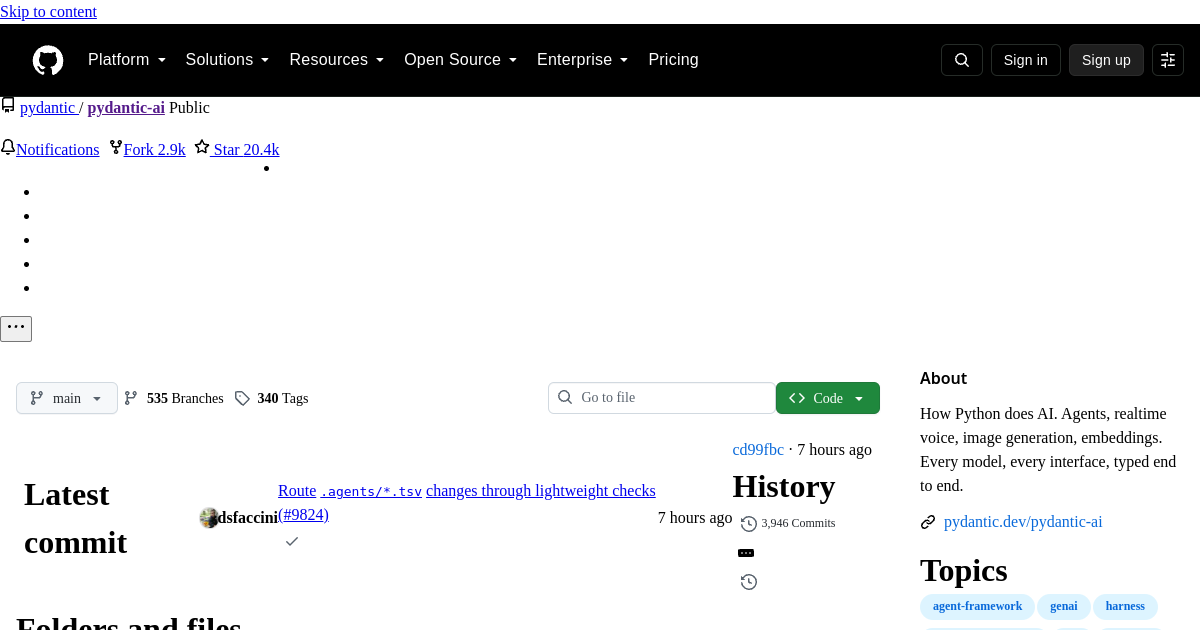
Pydantic AI is an open-source Python agent framework designed by the creators of Pydantic to help software engineers build production-grade AI applications. It combines strict type safety, data validation, and agent orchestration into a single developer-friendly library. By extending Pydantic models into LLM interactions, it ensures that model outputs conform to expected schema definitions before passing into business logic.
Developers use Pydantic AI to build autonomous agents, structured extraction pipelines, and multi-turn conversational tools. It simplifies tasks like parameter validation, tool calling, stream handling, and dependency injection in Python microservices. Engineering teams can quickly connect agents to databases, external APIs, and internal tools while maintaining code quality and full test coverage.
The main distinction of Pydantic AI is its emphasis on type safety and idiomatic Python design. Unlike generic agent wrappers, it relies on familiar Pydantic primitives and type hints rather than introducing heavy abstractions. The framework itself is completely free and open-source, though developers pay model providers directly for API tokens or infrastructure when running workloads.
For FutureStack, Pydantic AI belongs in Developer Tools because it provides core infrastructure for Python engineers building AI-native backends. It is best for developers, backend architects, and technical founders who need robust, type-checked AI agent workflows without sacrificing code maintainability.
Use Cases
Type-safe Agents
Build Python AI agents whose model outputs, tools, and dependencies are validated with typed schemas.
Structured Extraction
Extract reliable structured data from model responses using Pydantic validation and typed outputs.
Tool-based Agents
Connect agents to databases, APIs, internal tools, and business logic through Python functions.
Production AI Backends
Build maintainable AI services and agent workflows that fit naturally into existing Python applications.
Key Features
- Built-in integration with Pydantic for strict model validation and type safety
- Multi-model support across OpenAI, Anthropic, Gemini, and local models
- Structured output generation with automatic schema enforcement
- Dependency injection system for testable agent architectures
We may earn commissions from links to support our work. Learn more.
Explore with AI
Pricing summary
Pydantic AI is a free, open-source Python framework. Users pay model providers directly for API usage depending on their chosen LLMs.
Pricing & Plans
Free (Open Source)
Full framework access for open-source Python development.
Free
- Full framework access
- Open-source codebase
- Type safety validation
- Community support
Popular
Developer (BYOK)
Bring your own model keys for custom applications.
Free
- Bring your own keys
- All model integrations
- Local testing support
- Production deployment
Enterprise
Self-hosted deployment in enterprise Python stacks.
Free
- Self-hosted deployment
- Custom infrastructure
- Production validation
- Internal microservices
Other pricing notes
- The software library is completely free and open-source under the MIT license.
- External LLM API token costs apply when invoking commercial language models.
Pricing last checked: July 2026Official pricing
Pros & Cons
Pros
- Seamless integration with existing Python and Pydantic codebases
- Provides type safety and runtime validation for model responses
- Free and open-source framework with transparent architecture
- Supports popular LLM providers and custom local instances
- Simplifies complex agent orchestration in enterprise Python apps
Cons
- Primarily designed for Python developers rather than low-code users
- Requires familiarity with Pydantic and async Python patterns
- Underlying model API usage costs are paid directly to LLM vendors
- Evolving ecosystem with frequent updates to agent APIs
- Advanced orchestration workflows require custom Python code
The Best Pydantic AI Alternatives
The best Pydantic AI alternatives are LangChain, Mastra, and CrewAI.


Frequently Asked Questions
Reviews
Honest feedback from the FutureStack community.
0.00 ratings
No reviews yet. Be the first to share your experience.
Trending Tools on FutureStack
Discover the most popular and hand-picked AI tools across FutureStack




Pydantic AI
Developer Tools